Showing posts with label Top 10 reasons why I like Office 2007. Show all posts

Tuesday, November 27, 2007

Reason #5 why I like Office 2007: using Slide designs/layouts in Powerpoint 2007

PowerPoint XP gave us 'Multiple Masters'. Until then, we were limited to 2 master layouts: a Title master and a Content master. With multiple masters, we finally could create presentations with different, yet consistent background for different sections of our presentations.

The problem with multiple masters was that PowerPoint XP used a rather strange user interface for switching between the different masters. In Training sessions I gave, this topic always was one of the most confusing for trainees. You had to combine the "Slide Design" and "Slide Layout" panes in the Task Pane to get the layout you wanted, which was far from intuitive. PowerPoint 2003 did not improve in this area.

Finally, with PowerPoint 2007, Multiple Masters are really usable and pretty intuitive.
There's no difference anymore between "Slide Design" and "Slide Layout". When you need another layout, you simply click the "Layout" button. It will list all available layouts, for all masters in your presentation. With one click, you can change layout and/or master.
This is really an elegant solution to the complex issue of using Multiple Masters.

Friday, March 23, 2007

Reason #4 why I like Office 2007: the new file format

The new file format that Office 2007 uses is an XML-based file format, which is stored on the hard disk in a compressed format. A standard ZIP-compression is used, which means that you can open Office 2007 files in a zip-compatible application.

This opens a lot of possibilities, but what I really like about it is that you can easily extract images or other embedded documents out of Word, Excel or PowerPoint files.
Better yet, this (finally!) gives me an easy way to find out why a PowerPoint presentation has a huge file size, even though I used "Compress Pictures..." before I saved.

I could put this into practice today: a colleague asked for my help because he had a PowerPoint presentation with about 30 slides, some of which contained pictures, and the file size was 11MB. Too large to send as an e-mail attachment in our organization.

I first looked at the obvious things: no master slides that were not used, no pictures that were scaled down to 25% or less, all pictures compressed and cropped... nothing that would explain the 11MB.

So I opened the file in PowerPoint 2007, saved it as an .pptx-file, opened that with WinZip and sorted the list on file size. The result? The presentation contained 6 images in .wmf-format, which apparently take a lot of space.

I could not have seen that in PowerPoint 2003: the images themselves were less than 300x300 pixels and were scaled at 100%, so everything looked OK.

After replacing the pictures with a .jpg-version, the PowerPoint presentation shrank to a mere 3 MB!

Wednesday, February 28, 2007

Reason #3 why I like Office 2007: Conditional Formatting Power in Excel

I teach about Office 2003 regularly, and whenever I demonstrate the Conditional Formatting options in Excel 2003, one of the first questions I get is "Great, but can you have more than 3 conditions?". I have to disappoint people then, because the limit is 3. Until Excel 2007 arrived that is. In the new Excel 2007, you may have as many conditional formats as you like.

Better yet, a powerful series of commonly used Conditional Formatting rules are predefined, so visualizing information using color really is a matter of just a few clicks. The Conditional Formatting button also is prominently present on the Home tab of the Ribbon, an indication that the Excel team understands its power for users. I particularly like the Data Bars and Color Scales options:
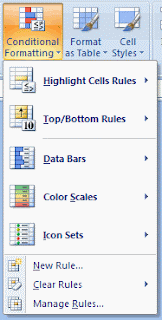
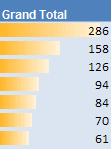
  • Data Bars display a color bar across cells to display the relative magnitude of values in a cell range. It makes is very easy to get a visual representation of your data:
  • Color Scales let you color cells using a color gradient. So you really can show subtle differences between numbers in different colors:

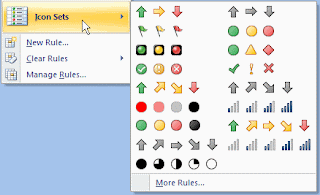
There are other options as well. I was excited about Icons Sets at first: it looked like the icons would allow for a nice indication of whether a value was going up or down:But I'm not so sure this option is as valuable as it looks like at first sight.
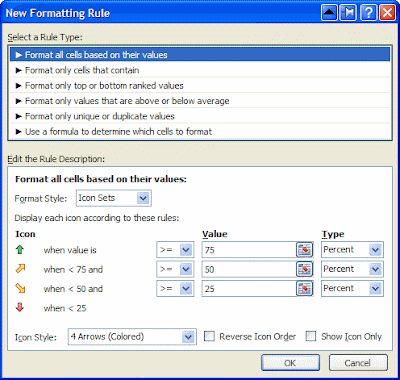
Suppose you have the following data about Sales in the first 5 months of the year:I'd like to use the 4 arrows option to quickly show whether data is going up or down, month by month. However, when I apply that arrow formatting on the range, this is the result:Not quite what I expected. The yellow arrows seems to indicate that February and March are better than January, but in fact, the trend is going down. Looking at the details of this predefined setup, I understand how Excel is using the arrows: They are used to represent a relative value in the whole range of the cells, not compared to the previous or next cell. I think this is confusing. There should be an easy way to use arrows indicating whether a value goes up, or down throughout a range, but I haven't been able to figure out how to do that. If you do, please let me know.
Having said that, the Conditional Formatting improvements in Excel 2007 are huge! What I covered here is in fact only the tip of the iceberg.

Tuesday, February 20, 2007

Reason #2 why I like Office 2007: The Selection Pane in PowerPoint

If you don't use PowerPoint a lot, you might not fully appreciate why I love the new Selection Pane in PowerPoint 2007. I often need to play around with various objects on my slide, e.g. using animation effects to build a complex figure or highlighting certain aspects of the slide text.

In previous versions of PowerPoint, with complex slides it was not easy to understand the animation sequence, as the shapes and groups in the Custom Animation Pane were labeled "Rectangle 14", "Arrow 26" or "Group 31". These names don't help a lot when trying to get a complex animation right.

This is still the case in PowerPoint 2007, but you can easily change the name to something meaningful! To start, display the Selection Pane by clicking the Select button in the Home tab of the Ribbon:This will give you access to a pane on the right hand side of the screen, displaying all elements on the slide:
Double-clicking any of these elements will allow you to rename them (giving them a meaningful name):
That way, it's a lot easier to work with the Custom Animation sequence:
Better yet, the Selection Pane also allows to select objects that are 'behind' other objects, e.g. to change the properties or to move them, without having to move the objects that are 'above' them.
An example will clarify this: suppose I have a slide with the Agenda of the presentation. I want to indicate that the next topic will be "Purpose of the Project" by putting a rounded rectangle behind the text: If I ever wanted to change something about the rectangle, like the color or custom animation, it was very difficult to select it in previous versions of PowerPoint: the text of the slide is in front of the rectangle, making it virtually impossible to select it. I had to move away the text or send the text "To Back" to get access to the rectangle. In PowerPoint 2007 it is as easy as selecting the rectangle in the Selection Pane!

Monday, February 5, 2007

Reason #1 why I like Office 2007: The Ribbon

The Ribbon is a bold move from Microsoft, but I believe it's the right one. As I mentioned in a previous post, your first encounter with the new User Interface might be a rough one, as it IS different from the menu system.At very first sight, you might think there still is a menu in Word, Excel and PowerPoint, as you still see "menu-like" words at the top, e.g. "View" or "Insert" or "Page Layout". But when you click on them, they don't open a menu, but the icons change at the top, giving you immediate access to the features you need the most.As an example, clicking "Insert" in Word 2007 will give you one-click access to the most common elements you are likely to insert in a document. Instead of going through a series of menu options to insert a Picture from your hard disk, you simply click the Picture icon.

Need to add the Page Number to your document? Simply click Page Number and you can immediately choose between some most common ways of formatting the page number. It really makes doing the most common things in Word, Excel and PowerPoint a lot easier and faster to find.

Bill Gates said during a keynote at PDC 05 that 9 out of 10 features that people request for the next version of Office... are already in the product. People just had difficulties finding them. A lot of the features were buried in submenus, obscure dialog boxes or task pane windows. The Ruler in Office 2007 makes finding a feature a lot easier, at least for most of the thing you'd like to do. It's pretty well organized, and you find most items where you expect them to be.

I've been using the Ruler for about a month now, and I hate it when I have to go back to a menu-driven system. Yes, it does take some time to learn a new way of working, but it very quickly pays out: you can focus more on the document you're creating or editing, instead of trying to find out how something works.

It's not perfect, and some strange decisions were taken (why do I need to go to "View" to get to Macros?), but overall, this will improve your productivity.

Friday, January 19, 2007

10 reasons why I like Microsoft Office 2007

Over the next weeks, I plan to publish the 10 (or so) reasons why I like the new Microsoft Office 2007 suite. It will be a collection of new features and different ways how to do things, which I hope will convince you that this is a significant upgrade.